RJ45 cable is one of the most common types of network cable used to connect computers, routers, switches, modems, IP cameras, and other networking devices. It plays an important role in wired Ethernet networks by providing a reliable connection for transferring data.
Whether you are setting up a home network, office LAN, gaming setup, or server environment, understanding RJ45 cables can help you choose the right cable and configure your network correctly.
What Is an RJ45 Cable?
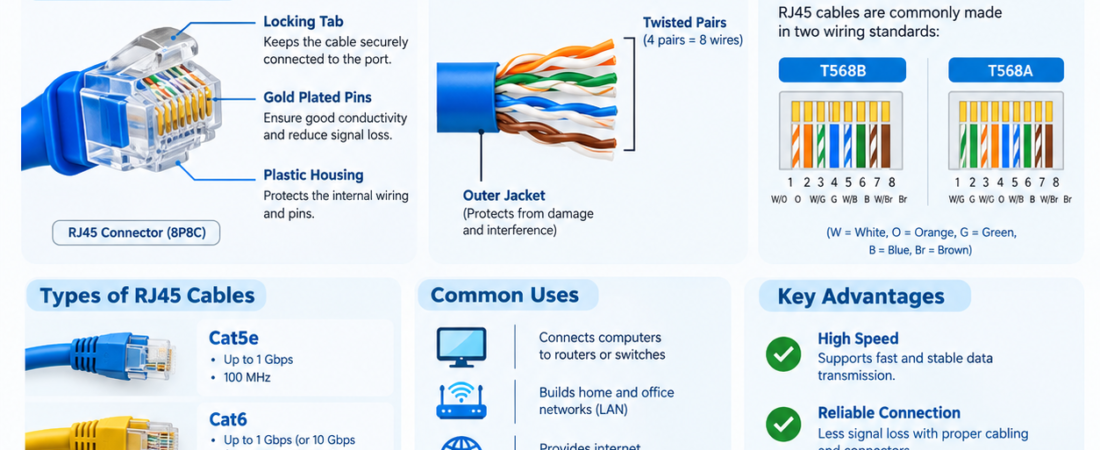
RJ45 is commonly used to refer to the connector and Ethernet cables that use an 8P8C modular connector. The connector has eight contacts that connect to the eight conductors inside a typical twisted-pair Ethernet cable.
RJ45 Ethernet cables are widely used for wired network connections because they offer stable communication, low latency, and reliable data transmission.
What Does an RJ45 Cable Look Like?
An RJ45 Ethernet cable normally consists of:
- An RJ45 connector at each end
- Eight copper conductors
- Four twisted pairs
- An outer protective jacket
- A locking tab on the connector
- Contact pins for connecting to the network port
The twisted-pair design helps reduce electromagnetic interference and crosstalk during data transmission.
RJ45 Wiring Standards: T568A and T568B
Two common wiring standards are used when terminating Ethernet cables: T568A and T568B.
The main difference between them is the arrangement of the orange and green wire pairs.
T568B Pinout
The T568B sequence is widely used for standard Ethernet patch cables:
- White/Orange
- Orange
- White/Green
- Blue
- White/Blue
- Green
- White/Brown
- Brown
T568A Pinout
The T568A sequence is:
- White/Green
- Green
- White/Orange
- Blue
- White/Blue
- Orange
- White/Brown
- Brown
For a normal straight-through Ethernet cable, the same standard is generally used at both ends.
Types of Ethernet Cable
RJ45 connectors are used with several categories of Ethernet cable. The cable category determines factors such as bandwidth and supported network speeds.
Cat5e
Cat5e is a popular choice for home and basic office networking. It can support Gigabit Ethernet under appropriate conditions and is commonly rated to 100 MHz.
Cat6
Cat6 provides improved performance and reduced crosstalk compared with Cat5e. It is commonly used for modern home and office networks and can support higher speeds over appropriate cable lengths.
Cat6a
Cat6a is designed for higher-bandwidth networking and can support 10 Gigabit Ethernet up to 100 meters under suitable installation conditions. It is commonly used in business networks and data-center environments.
Cat7 and Cat7a
Cat7 and Cat7a cables are designed with additional shielding and higher frequency specifications. They are generally found in specialized networking installations where higher performance and shielding are important.
Where Are RJ45 Cables Used?
RJ45 Ethernet cables have many applications, including:
- Connecting computers to routers
- Connecting routers to network switches
- Connecting network switches to computers
- Home and office LAN networks
- IP security cameras
- Network printers
- Servers and network storage
- Smart TVs and streaming devices
- Gaming consoles and PCs
- Data-center networking
RJ45 vs Wi-Fi
Both wired Ethernet and Wi-Fi can provide internet access, but they work differently.
An RJ45 Ethernet connection uses a physical cable, which can provide a stable connection and low latency. Wi-Fi provides wireless connectivity and offers greater convenience and mobility.
For stationary devices such as desktop computers, gaming PCs, servers, and smart TVs, Ethernet can be a useful option when a wired connection is practical.
How to Make an RJ45 Ethernet Cable
Making an Ethernet cable requires Ethernet cable, RJ45 connectors, a crimping tool, and a cable tester.
The basic process is:
- Measure and cut the required length of cable.
- Remove a small section of the outer jacket.
- Separate and straighten the twisted wires.
- Arrange the wires according to T568A or T568B.
- Trim the wires evenly.
- Insert them into the RJ45 connector.
- Use a crimping tool to secure the connector.
- Repeat the process on the other end.
- Test the cable with an Ethernet cable tester.
Using the same wiring standard on both ends creates a typical straight-through cable.
Advantages of RJ45 Ethernet Connections
Reliable Connection
A wired Ethernet connection is generally less susceptible to wireless interference than Wi-Fi.
Low Latency
Ethernet can provide a responsive connection that is useful for gaming, video calls, and other latency-sensitive applications.
High-Speed Data Transfer
Modern Ethernet cabling can support high network speeds when the cable, connectors, network interfaces, and networking equipment are compatible.
Easy Compatibility
RJ45 Ethernet ports are widely available on computers, routers, switches, access points, cameras, and other network equipment.
Cost-Effective
Ethernet cables are relatively inexpensive and can be installed in homes, offices, and other environments.
Common RJ45 Cable Problems
If an Ethernet connection is not working correctly, several things may be responsible:
- Damaged cable
- Incorrect wire order
- Poorly crimped connector
- Broken connector clip
- Loose network port
- Excessive cable length
- Damaged internal conductors
- Network equipment problems
A simple Ethernet cable tester can help identify wiring faults.
Frequently Asked Questions
Is RJ45 the same as Ethernet?
Not exactly. RJ45 is commonly used to describe the connector used with Ethernet cables, while Ethernet is the networking technology. In everyday usage, however, people often use “RJ45 cable” and “Ethernet cable” interchangeably.
Which RJ45 cable is best for home use?
For many home networks, Cat5e or Cat6 is sufficient. Cat6 can be a practical choice if you are installing new cabling and want additional bandwidth capability.
Can an RJ45 cable improve internet speed?
An Ethernet cable does not automatically increase your internet plan’s speed. However, a suitable wired connection can provide a more stable connection than Wi-Fi and can help you take full advantage of the speed supported by your network equipment and service.
How long can an Ethernet cable be?
For standard twisted-pair Ethernet installations, 100 meters (328 feet) is a commonly referenced maximum channel length. Actual performance depends on the cable category, installation, connectors, and networking standard being used.
Can I use Cat6 cable with a Cat5e device?
Yes. Ethernet equipment is generally designed to be backward compatible across supported cable categories, although the resulting connection will operate according to the capabilities of the devices and cabling.
Final Thoughts
RJ45 Ethernet cables remain an important part of modern networking. From simple home internet connections to business networks and data centers, they provide a practical way to connect network devices.
Choosing the right cable category, using the correct wiring standard, and properly testing the finished cable can help create a reliable wired network.